Why Transaction Simulation Has Become a Core Layer of DeFi Wallet Security
You are about to swap a stablecoin, approve a lending protocol, or claim a reward. The transaction appears ordinary: a familiar website, a connected wallet, and a button marked “Confirm.” Yet the information shown in many signing windows is often a technical data payload rather than a plain-language account of what will happen. A malicious contract, an excessive token approval, or a misleading interface can turn a routine click into an expensive mistake.
Transaction simulation addresses that gap by attempting to preview the outcome of a transaction before it is sent to the blockchain. For DeFi users in the United States, where a failed transaction can still consume network fees and where irreversible settlement leaves little room for appeal, this is more than a convenience feature. It is a change in the wallet’s role: from a passive signing tool to an interpretation and risk-screening layer.
From address books to transaction understanding
Cryptocurrency wallets originally focused on a relatively narrow task: holding private keys and producing valid digital signatures. That model made sense when the main user action was sending a native asset from one address to another. DeFi made the transaction model considerably more complicated. A single user action may call several contracts, move multiple tokens, update permissions, and depend on the state of a lending pool, exchange, bridge, or vault.
The visible button on a DeFi website therefore does not fully describe the instruction being signed. It is an interface for generating transaction data. The wallet receives that data, and the blockchain later determines its result according to contract code and current state. This distinction is important because a polished website can present an attractive description while the underlying call requests something broader or different.
Simulation works by evaluating a proposed transaction against a current or near-current representation of the relevant blockchain state. In simplified terms, a system asks: if this call were executed now, what assets would move, what permissions would change, would the call revert, and what state changes would it produce? The result can be translated into a more readable summary, such as a token leaving the wallet, another token arriving, or an approval being granted.
That process is not magic and it is not the same as proving that a transaction is safe. It is closer to a flight simulator than a guarantee of a safe flight. The simulation explores a prospective execution under particular assumptions. It can reveal consequences that are difficult to see in raw calldata, but it cannot eliminate the possibility that the website, contract, oracle, market, or blockchain state behaves differently by the time the transaction is mined.
What simulation can reveal—and what it cannot
The most useful mental model is to separate three questions. First, will the transaction execute, or will it revert? Second, what does the contract appear likely to do if it executes? Third, is that outcome appropriate for the user’s intention? Simulation is strongest on the first question and often helpful on the second. The third still requires human judgment.
A preview may expose a failed contract call before the user pays a network fee. It may also identify a token approval that allows a spender to use a much larger amount than the user expected, or show that a swap produces an unexpectedly small output. For a multi-step DeFi interaction, the preview can make otherwise hidden asset movements visible. This is especially valuable when the wallet is connected to several EVM-compatible networks, because the same-looking application can behave differently across chains.
Approvals deserve particular attention. A token approval is not generally the transfer itself; it is a permission for a designated contract or address to move tokens later, subject to the allowance. Users frequently treat an approval screen as a minor preliminary step, but its security meaning can be substantial. A simulation that distinguishes “you are swapping” from “you are granting spending authority” helps correct one of DeFi’s most persistent misconceptions: signing is not always equivalent to completing the visible action.
There are hard boundaries. A simulation depends on the state it can observe. Prices can move, liquidity can change, an oracle can update, and another transaction can be mined first. Some contracts use mechanisms that make outcomes difficult to model, including unusual token behavior, callbacks, dynamic permissions, or interactions across systems. A preview may also fail to capture the economic risk of a transaction that executes exactly as coded. A sandwich attack, impermanent loss, liquidation exposure, or a poorly designed protocol may not appear as a simple “failure.”
Even a successful simulation can therefore be misleading if the user asks the wrong question. “Does this transaction execute?” is not the same as “Is this protocol trustworthy?” or “Is this price fair?” Transaction simulation is a security control at the execution boundary, not a substitute for contract review, operational discipline, or understanding the product being used.
Why wallet design matters in the current EVM landscape
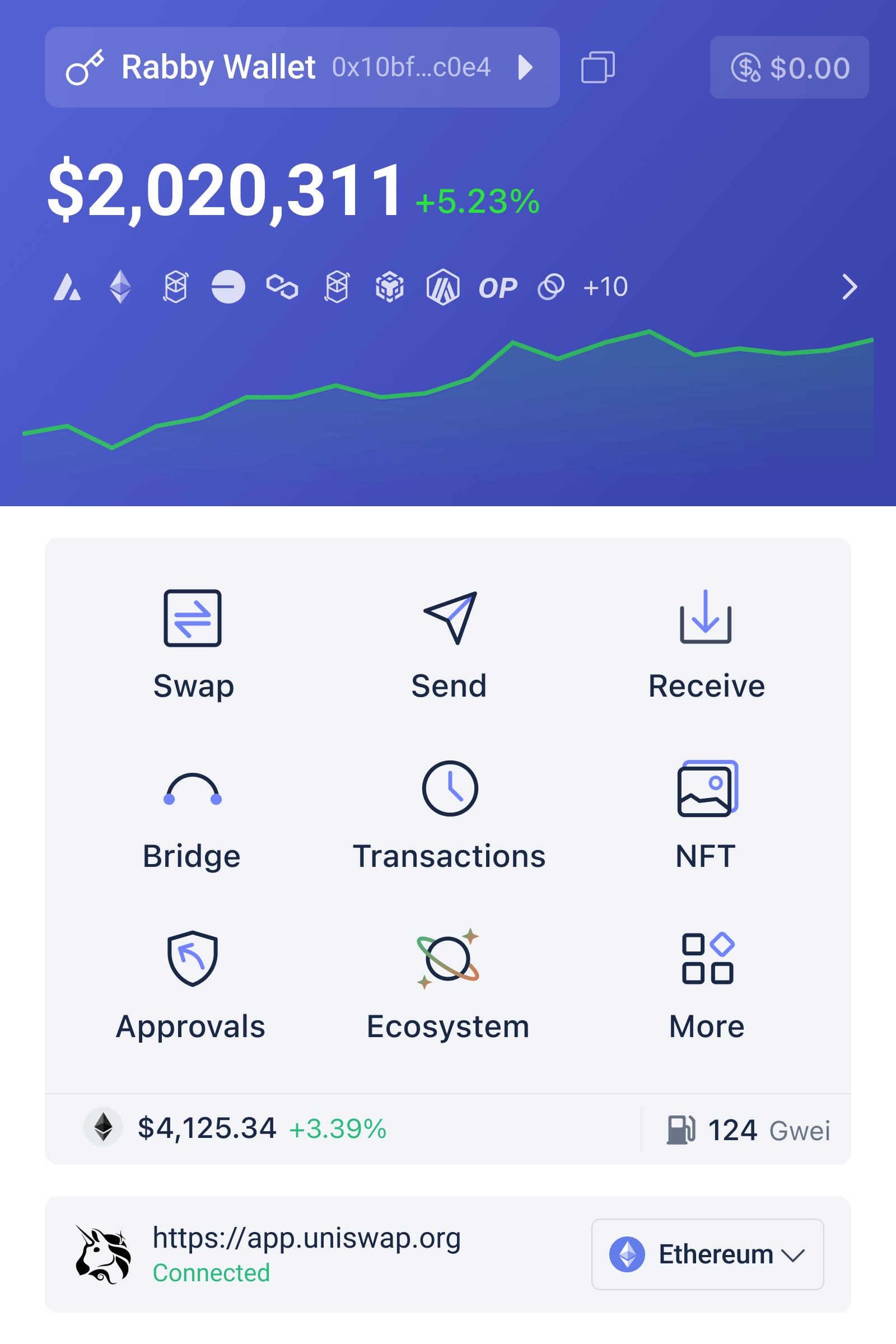
Recent Rabby messaging presents the wallet as a general-purpose interface for Ethereum and EVM networks, emphasizing on-chain activity across multiple chains and access through browsers such as Chrome and Brave. That positioning reflects a broader change in DeFi usage. Users no longer interact with one chain, one asset, and one application. They move between networks, bridges, decentralized exchanges, liquid staking systems, lending markets, and newly deployed contracts, often within the same session.
Multi-chain convenience creates a corresponding security problem: context switching. A user may believe they are reviewing a familiar transaction while the wallet is connected to another network, another token contract, or another version of an application. A useful wallet should make chain identity, recipient or spender, assets, permissions, and expected results legible before signing. The value is not merely visual polish. Clear context reduces the chance that a user will approve an action based on memory rather than on the transaction currently in front of them.
For someone preparing to install a browser extension, the security process begins before the first transaction. Use the project’s verified distribution path and check the extension’s identity rather than relying on a sponsored search result, an unsolicited message, or a link copied from a chat. Readers who need to locate the official installation information can review the rabby wallet download page, then confirm that the browser is installing the intended extension before importing or creating an account.
Installation security and transaction security are related but distinct. A good simulation feature cannot protect a seed phrase entered into a fake extension. Conversely, a genuine wallet cannot make an ambiguous DeFi contract safe merely by displaying a warning. The complete chain of protection includes the software source, the device, the private-key handling process, the connected website, the contract, the transaction parameters, and the user’s final decision.
A practical framework for reading a simulation
When a wallet presents a transaction preview, do not treat it as a traffic-light score that replaces thinking. Read it as an evidence panel. Start with the network. Confirm that the selected chain is the one intended and that the asset balances shown belong to that network. Then inspect the action: is this a transfer, swap, approval, contract interaction, or a sequence containing several of these?
Next, compare the expected asset movements with the purpose of the transaction. If the goal is to deposit one asset into a lending market, an unrelated token leaving the wallet is a reason to stop. If the goal is to swap one token for another, check whether the displayed output and minimum acceptable output make economic sense. If the wallet highlights a broad or unlimited approval, decide whether that permission is necessary and whether a smaller allowance would better fit the use case.
Finally, treat warnings and uncertainty as information, not as obstacles to click through. A warning may result from a known limitation in interpretation rather than proof of malicious behavior, but it still changes the decision. The appropriate response is to investigate the contract and application through independently obtained information, not to assume that a warning is merely a technical annoyance.
This framework produces a useful rule: verify intent, scope, and consequence. Intent asks whether the transaction matches what you meant to do. Scope asks what authority or assets you are giving away. Consequence asks what happens if the transaction executes under current conditions. Simulation improves the third question and often clarifies the first two, but the user remains responsible for connecting the preview to the broader protocol risk.
The deeper limitation: execution safety is not economic safety
One of the most important distinctions in DeFi security is between technical execution and economic outcome. A transaction can be technically valid, successfully simulated, and mined without error while still producing a poor result. Slippage, thin liquidity, volatile collateral, oracle design, governance changes, and counterparty assumptions can all create losses that are not equivalent to a contract revert.
This is why simulation should be understood as one layer in a defense-in-depth model. It can reduce blind signing and catch mismatches between a user’s stated intention and the transaction payload. It cannot establish that a protocol will remain solvent, that a token is liquid, that a bridge will honor a message, or that a market price reflects fundamental value. Security tools are most effective when their boundaries are explicit; otherwise, a helpful preview can create false confidence.
There is also an information problem. Human-readable summaries necessarily simplify complex calls. Simplification is beneficial when it exposes the important consequence, but dangerous when it hides unusual behavior behind a familiar label. As wallets improve their interpretation systems, an open question is how much detail to show without overwhelming non-specialists. The likely direction is not a single perfect summary, but layered disclosure: a plain-language result first, followed by contract, permission, and calldata detail for users who need to investigate further.
What to watch as wallet security develops
If transaction simulation becomes more reliable across EVM applications, its significance may extend beyond individual warnings. Wallets could become the main place where users compare intended actions with machine-readable contract behavior. That would shift competition among wallets away from simple asset display and toward interpretation quality, transparency, and the ability to explain uncertainty.
That outcome is conditional. It depends on simulation infrastructure keeping pace with new contract patterns, on warnings being understandable rather than excessively noisy, and on users learning that a preview is evidence rather than a guarantee. The useful signals to watch are practical: whether simulations cover more complex transactions, whether permission changes are clearly separated from transfers, whether unsupported cases are disclosed, and whether users can inspect the underlying contract context when a result looks surprising.
For DeFi users, the immediate lesson is less dramatic and more durable. Before signing, pause long enough to ask what the wallet says will leave, what authority will be granted, which network is involved, and whether the result matches the purpose of the action. A transaction simulation can make that pause informed. It cannot make the decision for you.
Frequently asked questions
Does transaction simulation guarantee that a DeFi transaction is safe?
No. It estimates or previews execution under particular blockchain conditions. It may reveal reverts, unexpected transfers, or broad approvals, but it cannot guarantee fair pricing, protocol solvency, resistance to manipulation, or safety from every contract design. Use it as one security layer rather than a certification.
Why should I review an approval differently from a swap?
A swap is generally intended to exchange assets during the current transaction, while an approval grants a spender permission to move tokens according to the allowance. An approval may therefore create continuing exposure beyond the immediate action. Check the spender, token, amount, and whether the permission matches your intended use.
What should I do if the simulation does not match what I expected?
Do not sign immediately. Confirm the network, reopen the application through a trusted route, inspect the contract and requested permissions, and compare the displayed asset movements with your intended action. If the mismatch remains unexplained, canceling is generally safer than treating the warning as an inconvenience.